
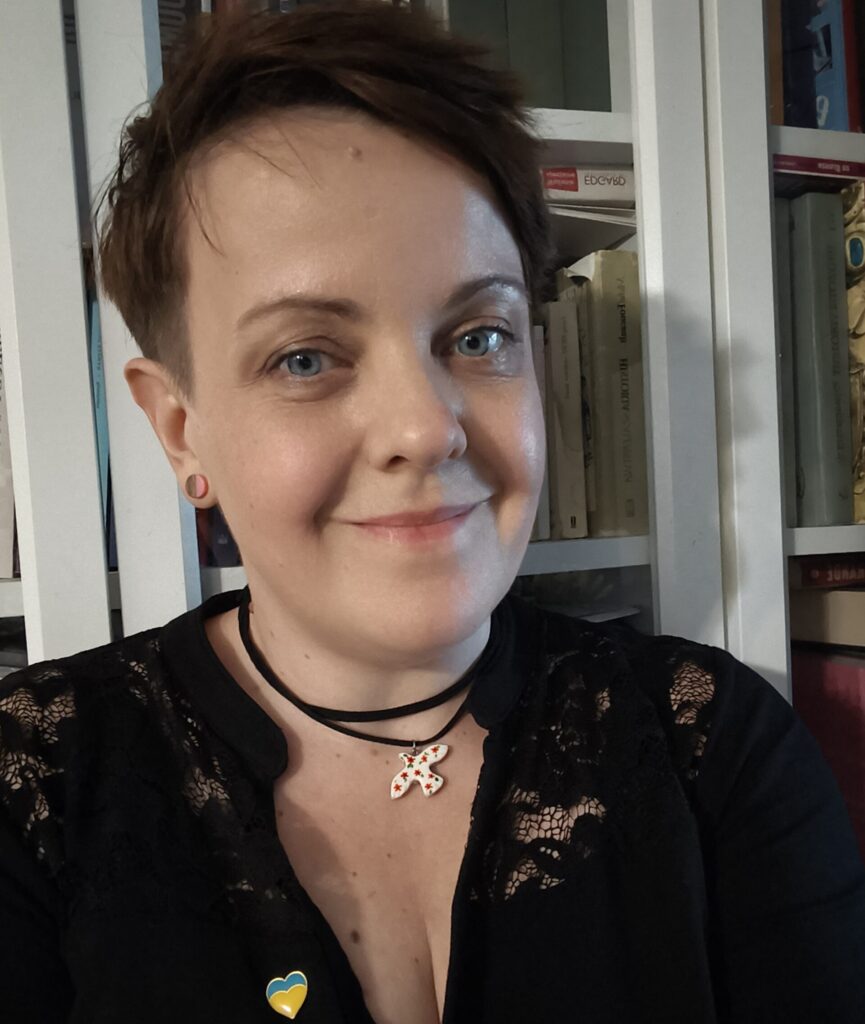
Sociologist and Social Researcher

Doctoral Researcher, University of Łódź

Katarzyna Krakowska

I am a sociologist and social researcher, currently pursuing a PhD at the University of Łódź. My research focuses on biographical methods, migration, and the social dimensions of language. I am particularly interested in how people make sense of their lives, experience migration, and negotiate belonging in times of social change.

In my work, I primarily employ qualitative research methods, with a particular emphasis on the biographical method. I specialize in Ukrainian studies, conducting research on migration experiences, language change, and contemporary social processes in Ukraine and among Ukrainians living in Poland.

About

A winding path into sociology

First-generation academic

Biographical methods

Ukraine and migration studies

I grew up in Ojrzeń, a small village in northern Mazovia during the turbulent years of Poland’s post-socialist transformation. My mother worked—and still works there—as a community midwife, while my father was a teacher. As you might imagine, I was always well prepared for school. Thanks to that, I was admitted to the best high school in the area, Henryk Sienkiewicz High School in Płońsk. Going to university seemed like the natural next step. Once I got there, however, nothing felt quite so straightforward.

I am a first-generation academic, and my path to sociology was long, winding, and far from linear. I studied several different subjects—managing to drop out of Russian Philology, Education Studies, and, on my first attempt, even Sociology itself. From the beginning of my studies, I worked a wide range of jobs. I ran a 24-hour internet café, tutored students, worked in customer service, insurance, and administration. Along the way, I encountered plenty of surprises, setbacks, and failures. Looking back, I think these experiences taught me curiosity about people and their stories.

Sociology, however, refused to give up on me. Years later, I returned to it as a student at Collegium Civitas in Warsaw, where I completed both my BA and MA degrees, and later joined the Department of Sociology as a staff member. I spent five intense and formative years there.

My time at Collegium Civitas (2019–2024) coincided with major global crises—the COVID-19 pandemic and the first years of Russia’s full-scale invasion of Ukraine. It was a period filled with teaching, but also with supporting students as they navigated an increasingly difficult reality. At the same time, I was searching for my own research path.

Gradually, I began to realise that all my interests converged in one place: people’s stories about their own lives. This is what led me to biographical research with Ukrainian refugee women aged 60 and over. That topic brought me directly to Łódź. In the Department of Sociology of Culture at the University of Łódź, led by Professor Kaja Kaźmierska, I found an academic environment where I truly felt at home and where I could further develop my interests in biographical methods and qualitative research.

I have also been fortunate to meet mentors who helped me believe that there was a place for me in academia. My supervisor, Professor Agnieszka Golczyńska-Grondas, has shown me from the very beginning that sociology can be practised with attentiveness, empathy, and social sensitivity. Professor Kamil Łuczaj, who invited me to join the BRAINY project, has patiently guided me through the world of academia, which for a long time felt unfamiliar and somewhat intimidating.

It was thanks, among other things, to their support that I found the confidence to submit my own research project to the National Science Centre. When it was awarded funding through the PRELUDIUM programme, I felt for the first time that I truly belonged in academia.

I am still learning what it means to be an academic. I continue to gain confidence, gather experience, and take pride in my work.

Research

Sociology of Migration and Life Narratives

My research centers on biographies and life narratives. I am interested in how people make sense of their experiences, interpret significant life events, and construct continuity in their personal histories. In my work, I primarily draw on Fritz Schütze’s autobiographical narrative interview method, using it both as a tool for data collection and analysis, alongside other qualitative research methods.

I am particularly interested in how individual lives are shaped by broader social, historical, and institutional processes. Biographical research allows me to examine large-scale social transformations through the lens of personal experience and to better understand how people navigate change, uncertainty, and major life transitions.

I study migration in its various forms, ranging from forced displacement to educational and professional mobility. I am interested in how migrants adapt to new environments, build social relationships, develop careers, and negotiate their sense of belonging.

My research explores refugee experiences, older adults’ migration trajectories, academic mobility, and the ways migration shapes everyday life, social relationships, identity, and biographical trajectories. I am particularly interested in migration as a biographical experience, the ways it reshapes daily life, and the role of language in processes of adaptation, relationship-building, and belonging.

I specialize in Ukrainian studies, bringing together sociological perspectives and area studies approaches. My research focuses on contemporary social processes in Ukraine and among Ukrainians living abroad, particularly in the context of war, migration, and the profound social transformations that have followed Russia’s full-scale invasion of Ukraine.

I view language not only as a means of communication but also as a central dimension of social life. My work examines the relationships between language, identity, and belonging, as well as the social and political contexts that shape language practices. I am especially interested in language change in contemporary Ukraine and the ways war and migration influence linguistic choices at both individual and collective levels. A significant part of my research also explores women’s experiences of war, displacement, and social change.

PROJECTS

Current and completed research projects​

CurrentPrincipal Investigator

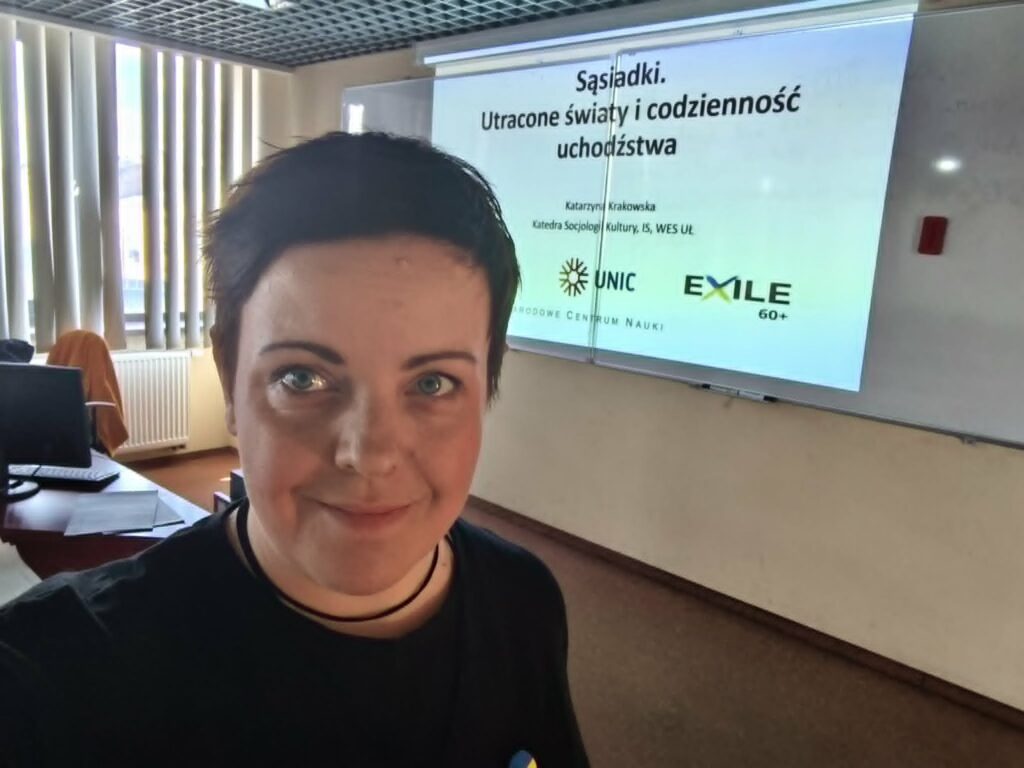
Ukrainian Women Aged 60+ in EXILE: Autobiographical Narratives of Forced Migrant Lives (EXILE 60+)

Host institutionUniversity of Łódź

DurationFebruary 2026 – February 2029

FundingNational Science Centre (NCN), PRELUDIUM 24 (UMO-2025/57/N/HS6/01879)

RolePrincipal Investigator

Project overview

EXILE 60+ explores how Ukrainian women aged 60 and over make sense of war, forced migration, and aging through autobiographical narratives. Based on interviews conducted in Ukrainian, Russian, and surzhyk, the project examines the relationships between biography, language, identity, and belonging in exile. 

By focusing on a group that remains largely overlooked in migration research, the project contributes to a better understanding of displacement, later life, and the social consequences of war. 

Research focus

Biographical Research · Forced Migration · Aging · Ukraine · Language and Identity 
Current

Biography and Academic Imaginarium: Polish Intellectual Diaspora in the Autobiographies of Migrant Scholars (BRAINY)

Host institutionUniversity of Łódź

DurationOctober 2024 – October 2029

FundingNational Science Centre (NCN), SONATA BIS (UMO-2023/50/E/HS6/00189)

RoleDoctoral Fellow

Principal InvestigatorKamil Łuczaj

Project overview

BRAINY explores the biographical experiences of Polish-born scholars working abroad. Through autobiographical interviews, memoirs, and personal narratives, the project examines how internationally mobile academics imagine places, academic systems, and their own migration trajectories. 

Focusing on Polish scholars in the United States, the United Kingdom, Canada, and Australia, the project investigates the relationships between migration, knowledge production, academic careers, and geographical imaginaries. 

Research focus

BRAINY explores the biographical experiences of Polish-born scholars working abroad. Through autobiographical interviews, memoirs, and personal narratives, the project examines how internationally mobile academics imagine places, academic systems, and their own migration trajectories. Focusing on Polish scholars in the United States, the United Kingdom, Canada, and Australia, the project investigates the relationships between migration, knowledge production, academic careers, and geographical imaginaries.

Current

Memory of Crimea: Oral History of the Crimean Tatar Community

Host institutionCrimean House Foundation (Fundacja Krymski Dom)

DurationJune 2026 – May 2027

FundingPolish-American Freedom Foundation through the RITA – Region in Transition Programme, implemented by the Education for Democracy Foundation

RoleMethodological Trainer & Fieldwork Mentor

Project overview

The project supports the documentation and preservation of the oral histories of Crimean Tatars, with a particular focus on the intergenerational memory of the 1944 deportation and its contemporary legacies. It combines researcher training, international collaboration, and the creation of a digital oral history archive. My role is to provide methodological training in autobiographical interviewing and to support the Ukrainian research team throughout the fieldwork, offering ongoing consultations on research design, interviewing, ethics, and qualitative data collection. The project will result in approximately 30 biographical interviews and an openly accessible digital archive preserving the cultural heritage of the Crimean Tatar community.

Partner: NGO Centre for Crimean Studies (Kyiv)
Output: Digital Oral History Archive (in preparation)

Research focus

Polish-American Freedom Foundation through the RITA – Region in Transition Programme, implemented by the Education for Democracy Foundation

Current

MIGRAEDU: Understanding Migration Realities: Teaching Migration Studies in Diversifying Societies

Host institutionCollegium Civitas (in partnership with the Research Institute for Quality of Life, Romanian Academy)

DurationSeptember 2024 – July 2026

FundingPolish National Agency for Academic Exchange (NAWA), Strategic Partnerships Programme (BNI/PST/2023/1/00135/U/00001)

RoleResearch and Educational Specialist

Principal InvestigatorMonika Nowicka

Project overview

MIGRAEDU combines research and education to address the needs of Ukrainian refugees with disabilities and other special needs in Poland and Romania. The project develops research-based e-learning materials on refugee assistance, humanitarian action, civil society engagement, refugee integration, and research ethics. 

My work focuses on the development of educational materials and the evaluation of project outcomes. The project also contributes to strengthening research and teaching capacities through international collaboration and student engagement. 

Research focus

Forced Migration · Refugee Studies · Disability · Research Ethics · Research-Led Teaching

Completed

Engagement Neutrality Hostility: Polish Society and the Refugee Crisis Following Russia’s Invasion of Ukraine

Host institutionCollegium Civitas

DurationMarch 2022 – August 2022

FundingRector’s Grant, Collegium Civitas

RoleResearcher

Project overview

This qualitative research project examined how people in Poland experienced and understood their involvement in supporting refugees from Ukraine following Russia’s full-scale invasion. Using ethnographic methods, including participant observation, interviews, autoethnography, and netnography, the study explored emerging forms of solidarity, social relations, and civic engagement during the first months of the refugee response.
The project resulted in the collective monograph Społeczeństwo łatwopalne. Praktyki pomagania uchodźcom wojennym z Ukrainy w 2022 roku w Polsce (Flammable Society: Practices of Helping Ukrainian War Refugees in Poland in 2022).

Research focus

Forced Migration · Civil Society · Humanitarian Action · Qualitative Research · Ukraine

Completed

PASSION Partnership for Sustainable Development and Social Innovation

Host institutionCollegium Civitas

Duration2019 – 2022

FundingPolish National Agency for Academic Exchange (NAWA), Academic International Partnerships Programme (PPI/APM/2019/1/00096)

RoleResearch Assistant and Researcher

Principal InvestigatorKatarzyna Iwińska

Project overview

PASSION was an international partnership focused on sustainable development, social innovation, and higher education. Bringing together universities from Poland, Greece, Portugal, Iceland, Sweden, and the United Kingdom, the project combined comparative research, educational innovation, and international knowledge exchange. 

My work involved research activities and project coordination support. The project contributed to the development of new educational resources, research outputs, and competency frameworks for future leaders of social and environmental change. 

Research focus

Sustainable Development · Social Innovation · Higher Education · International Collaboration · Educational Innovation

Completed

Theatre Pedagogy and Youth Participation in the Jan Dorman Competition

Host institutionZbigniew Raszewski Theatre Institute, Warsaw

Duration2023–2024

FundingMinistry of Culture and National Heritage (Poland)

RoleResearcher, Co-author

Project overview

This project explored theatre pedagogy, cultural participation, and the involvement of young people in creative processes developed within the framework of the Jan Dorman Competition. Drawing on qualitative research conducted in collaboration with theatre practitioners and educators, it examined how theatre-based activities can foster participation, dialogue, learning, and agency among young audiences. The project resulted in the open-access volume Praktykując pedagogikę teatru. Pojęcia, wartości, przykłady (2025), to which I contributed as co-author of two research-based chapters.

Completed

Analysis of the Context for Planning the Library Development Program

Host institutionPolish-American Freedom Foundation

Duration2008

FundingPolish-American Freedom Foundation

RoleResearcher, Co-author

Project overview

This pilot research project was conducted during the planning phase of the Library Development Program, one of the largest initiatives supporting public libraries in Poland. Working as part of a research team led by Aleksander Tarkowski and Mirosław Filiciak, I contributed to an analysis of existing library initiatives, digital inclusion programmes, and the role of libraries in local communities. The study provided evidence and recommendations that informed the design of the nationwide programme.

Publications

Selected publications
and academic outputs

My publications focus on biographical research, migration, language, and contemporary social processes related to Ukraine. I am particularly interested in the ways individuals make sense of displacement, belonging, and social change through autobiographical narratives. My work combines qualitative and biographical methods with perspectives from migration studies, sociology of language, and Ukrainian studies.

Below you will find a selection of recent publications as well as a complete list of my academic outputs.

Selected Publications

Full Publication List

2026IN PRESS

Book chapter

Between Work Ethic and Ethic of Care: The Aid Rush in Poland after the Outbreak of Full-Scale War in Ukraine in 2022

Krakowska, K., & Kalinowska, K. (2026, in press). In K. Kaźmierska & K. Waniek (Eds.), War in Ukraine: Between Lived Experience and Public Discourse (pp. 139-159). Brill.

2025

Article

Imagining Poland: Exploring Geographical Imaginaries in the Ukrainian War Refugee Narratives

Łuczaj, K., & Krakowska, K. (2025). Geoforum, 166, 104394.

Book chapter

Gratitude, Gratefulness, and Indebtedness. The Case of Ukrainian Refugees Hosted in Polish Households (2022-23)

Łuczaj, K., & Krakowska, K. (2025). In M. Dziekońska & K. Łuczaj (Eds.), Assistance to Ukrainian War Refugees in Central Europe. Palgrave Macmillan.

2024

Article

Zarys biografii językowej jako wprowadzenie do socjologicznie zakorzenionej analizy procesów społecznych w narracjach autobiograficznych uchodźczyń wojennych z Ukrainy. Przypadek Lesi

Krakowska, K. (2024). Przegląd Socjologiczny, 73(4), 35-59.

Article

Trudnoshti ta vyklyky pid chas nadannia dopomohy ukrainskym bizhentsiam staiut pozhyvoiu dlia kremliivskoi dezinformatsii

Krakowska, K. (2024). Polsko-Ukraińskie Studia Interdyscyplinarne, 1(12), 33-42.

2023

Book

Społeczeństwo łatwopalne: praktyki pomagania uchodźcom wojennym z Ukrainy w roku 2022 w Polsce

Kalinowska, K., Kuczyński, P., Bukraba-Rylska, I., Krakowska, K., & Sałkowska, M. (2023). Warszawa: Collegium Civitas.

Article

Dlaczego Polacy pomagali Ukraińcom? Typologia powodów zaangażowania w pomoc ukraińskim uchodźcom

Kalinowska, K., Krakowska, K., & Sałkowska, M. (2023). Kultura i Społeczeństwo, 67(3), 41-64.

Book chapter

Zaplecza pomocy. Społeczna teoria samoorganizującego się chaosu

Krakowska, K. (2023). In Młoda socjologia o społeczeństwie (pp. 108-125). Oficyna Wydawnicza Impuls.

Book chapter

Wspólnota i walka. O pomocy ukraińskich migrantów w Polsce niesionej uchodźcom wojennym z Ukrainy wiosną i latem 2022 roku

Krakowska, K. (2023). In Migracje i uchodźstwo ludności - trendy, problemy, wyzwania (pp. 123-141). Wydawnictwo Naukowe TYGIEL.

2022

Article

Teaching Sustainable Development Goals to University Students: A Cross-Country Case-Based Study

Vasconcelos, C., Silva, J., Calheiros, C. S. C., Mikusiński, G., Iwińska, K., Skaltsa, I. G., & Krakowska, K. (2022). Sustainability, 14(3).

2018

Article

The Role of the Volhynian Massacres in the Building of Narratives about Ukrainians on the Polish Internet

Krakowska, K. (2018). Zoon Politicon.

Academic Profiles

Research identifiers
and profiles

Official academic profiles with publication records, identifiers, and institutional research information.

Teaching & Engagement

Teaching &
Engagement

I believe that sociology matters most when it helps us better understand the world around us. For this reason, teaching, public engagement, and academic service are not separate from my research but an integral part of it.

Whether I am working with students, collaborating with community partners, or sharing research beyond academia, I see these activities as opportunities to encourage curiosity, critical thinking, and a deeper understanding of social realities.

Teaching

Teaching is one of the most rewarding aspects of academic life for me. I see the classroom not only as a space for sharing knowledge, but also as a place where students can develop sociological imagination, learn to ask questions, challenge assumptions, and become more attentive to the complexity of social life. I encourage students to look beyond stereotypes and simplified explanations, to consider different perspectives, and to understand how individual experiences are shaped by broader social, cultural, and historical contexts.

My teaching draws on both academic research and practical research experience. Whether discussing research methods, migration, or social theory, I aim to help students develop analytical skills, intellectual curiosity, and confidence in their own ability to investigate and understand the social world.

Selected Teaching Areas

Academic
Community

I see academic life as a collaborative endeavor built on dialogue, exchange, and mutual support. Beyond my own research and teaching, I actively engage in academic communities that bring together scholars interested in biography, migration, qualitative methods, and social change. These networks provide opportunities for intellectual exchange, interdisciplinary collaboration, and the development of new research initiatives.

I am particularly committed to supporting spaces where early-career and established researchers can learn from one another, share ideas, and contribute to the advancement of sociological knowledge.

Since 2026

Board Member

Biographical Research Section,
Polish Sociological Association

Since 2026

Member

Ukrainian Oral History Association

 
Since 2026

Member

European Sociological
Association

Since 2025

Member

International Sociological
Association

Since 2022

Member

Polish Sociological
Association

2019 - 2021

Academic Supervisor

Sociology Student Research Circle,
Collegium Civitas

2017 - 2019

Chair

Sociology Student Research Circle,
Collegium Civitas

Public Engagement

Public Engagement

I believe that sociological research should contribute to public understanding of the social world. For this reason, I actively engage in activities that bring research findings beyond academia and into broader public conversations. Through public talks, educational events, podcasts, and collaborations with non-academic audiences, I seek to share sociological perspectives on migration, displacement, language, social solidarity, and social change.

These activities are closely connected to my research and provide opportunities to discuss complex social issues in ways that encourage curiosity, critical reflection, and evidence-based understanding.

Selected Activities

2026

Science Festival (University of Łódź)EXILE 60+: Ukrainian Women Aged 60+ in Exile

2026

Science Festival (University of Łódź)BRAINY: Biography and Academic Imaginaries of the Polish Intellectual Diaspora

2024

Public Debate: Women in Migration CrisesHistory Meeting House, Warsaw

2023

Podcast (in Polish): „Dlaczego Polacy pomagali? Powody zaangażowania w pomoc Ukrainie”Discussion of research findings from the project Zaangażowanie – neutralność – wrogość: polskie społeczeństwo wobec kryzysu uchodźczego i wojny rosyjsko-ukraińskiej.

Conferences & Scholarly Exchange

Conferences, seminars, and research workshops are valuable spaces for intellectual exchange, networking, and engaging with diverse scholarly perspectives. I regularly present my research at national and international conferences and participate in interdisciplinary networks connecting sociologists, migration scholars, oral historians, and qualitative researchers.

I also take part in international research training and mobility programmes, including 

the Winter School on Ukrainian Migration in Europe and Globally (Munich, 2026) and a research residency at the Lviv City History Centre (Lviv, Ukraine, 2026).

Selected Presentations

2026

PIASA Congress, Lublin, Poland
The Category of “Eastern European” in the Autobiographies of Polish Intellectual Diaspora

2025

5th ISA Forum of Sociology, Rabat, Morocco
„Nezlamna Kalyna”: Biographical Processes of Becoming a Ukrainian Activist in Forced Exile

2025

5th ISA Forum of Sociology, Rabat, Morocco
Geographical Imaginaries of America: Biographical Experience, Migration, and the Habitus of Polish Intellectuals across Three Centuries

2024

Ukrainian Oral History Association Conference, Uzhhorod, Ukraine
The Narrative Biographical Interview Method in Research on Refugee Experiences

2023

Conference of the Biographical Research Section, Polish Sociological Association, Łódź, Poland
Forced Migration in the Autobiographical Narratives of Older Ukrainian Women

Recognition

I am grateful to have received recognition for my research, teaching, and academic engagement at different stages of my career.

2026

Recognition Award for Service to the University of Łódź
(to be formally awarded in October 2026)

2023

Zygmunt Bauman Award
co-author of Społeczeństwo łatwopalne

2023

Rector’s Award for Excellence in Teaching
Collegium Civitas

Contact

Get in touch

For research collaboration, speaking invitations, or academic enquiries, please feel free to contact me.